Case Study: Automating Unstructured Document Processing via Secure Enterprise AI for an Operations Hub
The Overview
Client Profile: A high-volume professional services hub handling cross-border trade, logistics, and legal documentation.
The Problem: The client's operations team spent over 25 hours per week manually extracting data from unformatted vendor invoices, shipping manifests, and customs declaration forms. This operational bottleneck delayed client billing cycles and introduced a 4% human error rate in data entry.
The Mission: Design and deploy a secure, private automated processing agent to ingest unstructured PDF documents, extract line-item details with 99%+ accuracy, cross-reference them with regional trade tax codes, and export structured datasets directly into their internal management database.
The Operational Challenge: Moving Past Public AI APIs
The client could not use public tools like standard ChatGPT or Claude APIs due to strict data privacy rules and PDPA compliance guidelines. Uploading sensitive proprietary client manifests and financial logs to public training models was out of the question.
⚡ Security Mandate: They required a completely sandboxed environment where data stayed within their sovereign infrastructure.
Technical Architecture & Implementation Breakdown
Our engineering suite at ML Systems Integrator (MLSI) executed a multi-phased secure deployment on-site from our central Singapore hub:
Phase 1: Security Sandboxing & Firewall Configurations
Before a single line of data engineering occurred, we secured the infrastructure perimeter.
- Perimeter Lockdown: Configured dedicated, isolated virtual environments protected by FortiGate Next-Gen Firewalls.
- Access Control: Implemented strict Multi-Factor Authentication (MFA) and granular Role-Based Access Control (RBAC). Only authenticated operational staff could trigger the document processing engine.
Phase 2: Data Sanitization & Retrieval-Augmented Generation (RAG)
Unstructured documents vary wildly in format. We engineered an intelligent data processing pipeline:
- OCR Parsing: Used enterprise-grade Optical Character Recognition (OCR) systems to extract raw textual matrices from scanned, low-resolution PDFs.
- Vector Embeddings: Converted parsed text into localized mathematical vector arrays using secure embedding models, matching them cleanly against an internal database of local customs regulations and invoice taxonomies.
Phase 3: Fine-Tuning the LLM Automation Agent
We integrated a specialized, local large language model (LLM) fine-tuned specifically for B2B financial and administrative processing.
- Prompt Engineering Optimization: Structured deterministic validation routines. If the AI agent detected an anomaly or a confidence score below 98% on a line item, the document was automatically rerouted to a human operator for validation.
- Integration: The structured JSON outputs generated by the AI agent were integrated into their local server stack, mapping fields like Invoice Number, Tax Breakdown, and Vendor Reference automatically into their legacy systems.
Step-by-Step Data Flow Architecture
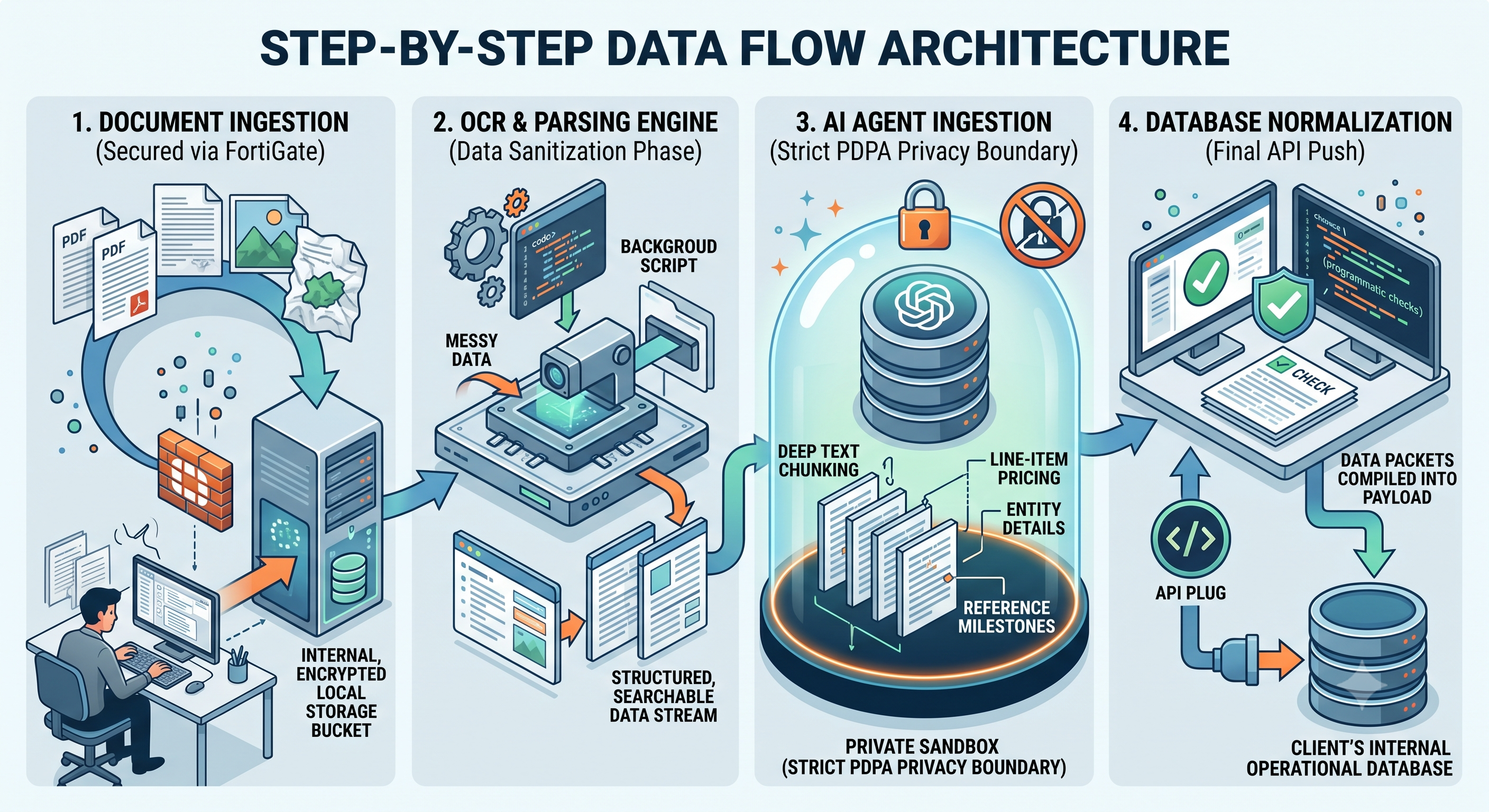
- 1. Document Ingestion: Secured via FortiGate. The operations manager uploads raw scanned PDFs or images into an internal, encrypted local storage bucket.
- 2. OCR & Parsing Engine: Data Sanitization Phase. The background script isolates the file, standardizes the formatting, and runs advanced OCR to convert visual text into a structured, searchable data stream.
- 3. AI Agent Ingestion: Strict PDPA Privacy Boundary. The secure, localized AI model runs deep text chunking to extract line-item pricing, entity details, and reference milestones without leaking data outside the private sandbox.
- 4. Database Normalization: Final API Push. The data is verified by the engine's programmatic checks, compiled into a clean data payload, and pushed directly into the client's internal operational database.
Strategic Business Outcomes
| Operational Performance Metric | Legacy Manual Workflow | MLSI Enterprise AI Framework |
|---|---|---|
| Average Document Processing Time | 12.5 Minutes per file | Under 18 Seconds per file |
| Data Extraction Accuracy Rate | ~96% (Human entry fatigue) | 99.7% Verified Accuracy |
| Weekly Ops Resource Allocation | 25+ Hours | Less than 2 Hours (Exception validation only) |
| Billing Cycle Velocity | T+4 Days | Same-Day Processing |
🚀 Accelerate Your Operational Performance
Don't let legacy, manual administrative processes cap your firm's scalability. Partner with a local Singapore team that understands how to safely marry advanced technology with tight data compliance frameworks.
Book a Private Consultation with our AI Transformation Team Today.